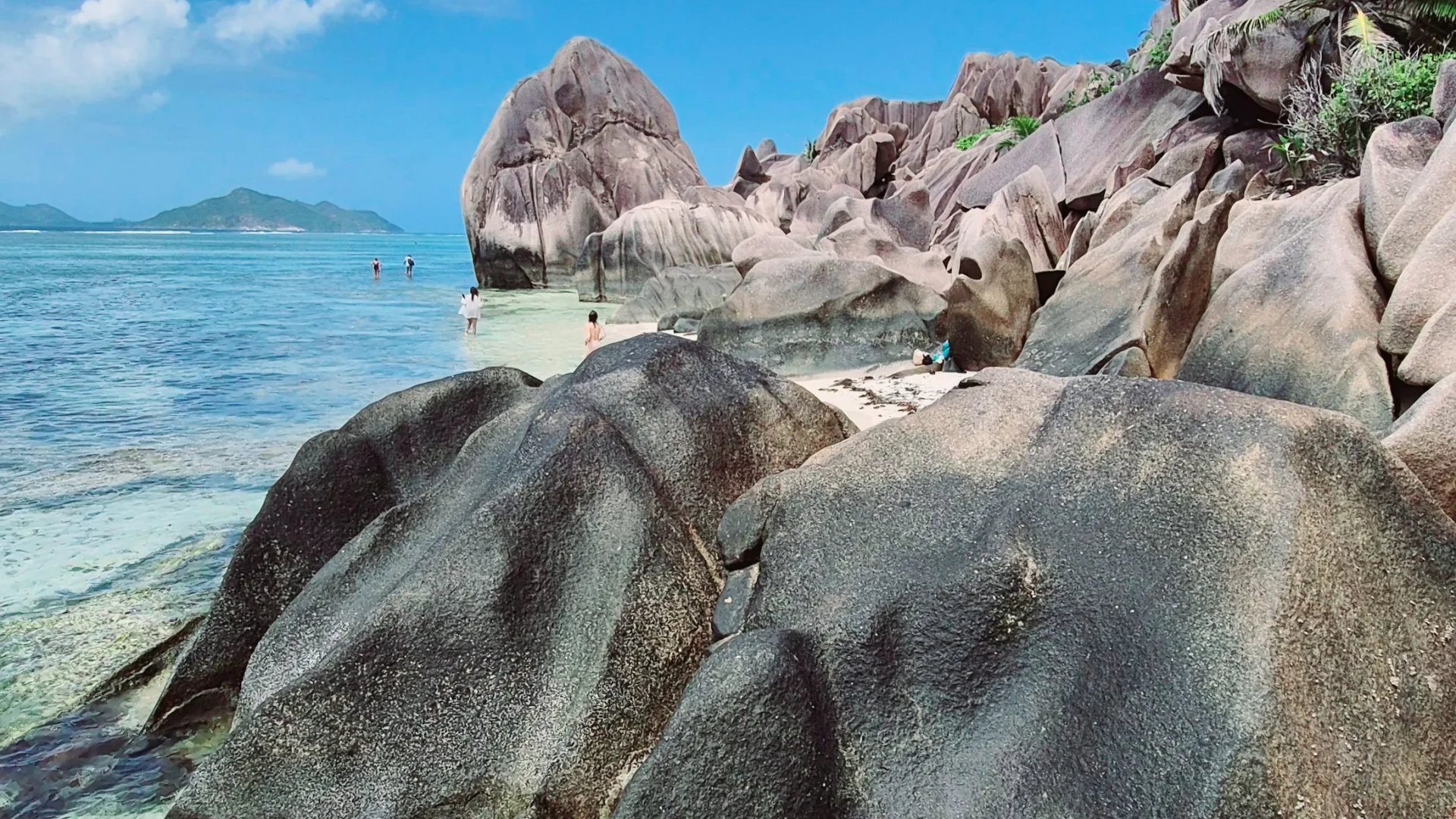
The postcard shot everyone has seen — smooth granite boulders framing a white-sand cove — is Anse Source d'Argent on La Digue, and the strange thing is that it's exactly as good in person, which is rare for a place that famous. What the photos don't convey is how spread out the Seychelles actually are: 115 islands scattered across 1.4 million square kilometres of ocean, of which only three (Mahé, Praslin, La Digue) have any real tourism infrastructure. Most first-time visitors make the same error as with the Maldives — booking one resort and never leaving it — when the real Seychelles experience is island-hopping between Mahé's mountainous interior, Praslin's Vallée de Mai (home to the absurd coco de mer palm), and La Digue's car-free, ox-cart pace. It's also unapologetically expensive; there's no real backpacker version of this destination, and pretending otherwise just gets you a worse room for not much less money.
Mahé is the main island — the international airport, the capital Victoria, and the most varied terrain, with mountain rainforest right behind the beaches. Praslin is the second-most-developed, home to the UNESCO-listed Vallée de Mai and some of the best beaches (Anse Lazio, Anse Georgette). La Digue is smaller, largely car-free (bicycles and ox-carts are the norm), and has the iconic Anse Source d'Argent. Most good itineraries split time across at least two of the three.
TravelBuzzy Tips
Spend at least 3 nights on Mahé, 3 on Praslin, and 2 on La Digue if doing all three — rushing any of them defeats the purpose
La Digue's lack of cars is a genuine feature, not an inconvenience — rent a bike on arrival
Anse Lazio on Praslin is consistently ranked among the world's best beaches and is far less crowded than La Digue's Anse Source d'Argent
The Seychelles sits just outside the main cyclone belt, so it's a viable year-round destination, but two monsoon seasons shape conditions: the southeast trade winds (May–September) bring cooler, breezier, choppier-sea weather good for windsurfing but less ideal for calm-water snorkelling; the northwest monsoon (December–March) is hotter and more humid with occasional heavy showers. April–May and October–November are the transition months — the calmest seas, least wind, and best all-round conditions.
TravelBuzzy Tips
April–May and October–November offer the calmest water for swimming and snorkelling
July–August can be genuinely windy — good for watersports, less pleasant for beach lounging
December–January is hot, humid, and the priciest period due to Christmas/New Year demand
Inter-island travel runs on a mix of short domestic flights and ferries. Mahé to Praslin is a 15-minute flight or a roughly 1-hour high-speed ferry; Praslin to La Digue is a quick 15–30 minute ferry. Booking these in advance during peak season (July–August, December–January) is worth doing, as popular ferry times sell out. Most visitors build a Mahé–Praslin–La Digue loop rather than trying to add further outer islands, which require chartered flights and considerably higher budgets.
TravelBuzzy Tips
Book the Praslin–La Digue ferry in advance during peak months — the popular midday departures fill up
The Mahé–Praslin flight has strict baggage weight limits — pack light or ship excess luggage ahead with your hotel's help
Outer islands (Desroches, Alphonse) are stunning but require a separate charter flight and a much bigger budget — treat them as a distinct trip
On Mahé, taxis and hotel transfers are the norm; renting a car is possible and useful for exploring the mountainous interior and less-visited beaches, though roads are narrow and steep. Praslin has taxis and a limited bus service. La Digue is the outlier — bicycles are the default transport, with a handful of ox-carts and pickup-truck taxis for luggage and longer trips; there is essentially no car rental culture there and you shouldn't need one.
Seychellois Creole cuisine centres on fresh fish (grilled red snapper, tuna, kingfish), octopus curry, and rice with a tamarind- or coconut-based sauce, with strong Indian and French influence. Resort dining is generally excellent and the default for most visitors, but small Creole restaurants in Victoria (Mahé) and beachside takeaway shacks offer better value and, often, better fish than the hotel buffet. Fresh fruit — including breadfruit and the Seychelles' famous jackfruit — is worth seeking out at local markets.
TravelBuzzy Tips
Victoria's Sir Selwyn Selwyn-Clarke Market is the best place for an inexpensive, authentic Creole lunch
Octopus curry is a Seychellois specialty worth ordering wherever it's on the menu
Grocery prices are high across the islands (most food is imported) — factor this in if self-catering
Tours & Experiences
Book your days in Seychelles
Skip-the-line tickets, guided tours, and day trips in Seychelles — free cancellation on most, confirmed instantly.
Get Price Alerts for Seychelles
We'll notify you when flight or hotel prices drop for your chosen month.
A private island resort with just 11 villas, a rewilded ecosystem, and a guest list that has included royalty on their honeymoon — the single most exclusive stay in the Indian Ocean.
A large but well-designed resort on Mahé spanning 120 hectares between two beaches, with five restaurants and views over the Port Launay Marine National Park.
Simple self-catering units on La Digue, a short walk from the ferry jetty and Anse Severe beach, the most affordable way to base yourself on the island.
*Prices shown are indicative and may vary. TravelBuzzy earns a commission on bookings made through these links, at no extra cost to you. Full disclosure