
Best Time to Visit Marrakech — A Month-by-Month Reality Check
The brochure says spring or autumn. The reality is more nuanced — including two months we'd avoid and one most visitors skip that we now think is the best of the year.
Most planning guides for Marrakech tell you to visit in March–May or September–November. They aren't wrong, but they're useful in roughly the same way a textbook is useful — the answer they give is the average answer, not the best one. After six trips spread across every season, here is the calendar I actually use when I'm planning a friend's first visit. The short version: October is the single best month, January is the most underrated, July and August are genuinely hard, and Ramadan is a wildcard that depends entirely on whether you want to experience it.
Planning this trip?
Find flights now
Compare prices across 700+ airlines and OTAs in one search — find the real lowest fare without the inflated middleman markup.
Search flightsNeed a place to stay?
Search hotels
October — the best month, and the one nobody warns you to book early
October in Marrakech is what spring feels like in most other Mediterranean destinations: 22–28°C in the day, 12–16°C at night, low humidity, almost zero rain, and the Atlas Mountains visible from rooftop terraces almost every clear morning. Crowds drop sharply after the European school holidays end (around the first week), and prices follow within 7–10 days. Riad rates are typically 30–40% below the November–December peak. The Medina is at the right ambient temperature for daytime walking, the souks aren't overheated, and the rooftop dinner culture (which doesn't really work in summer because of the heat) is at its best. Book at least 4 weeks ahead. October fills up.
Editor's tips
- Mid-October to first week of November is the sweet spot — late October Atlas Mountain trekking is also at peak window
- Marrakech International Film Festival is in late November/early December — riad rates spike for that week, so target before
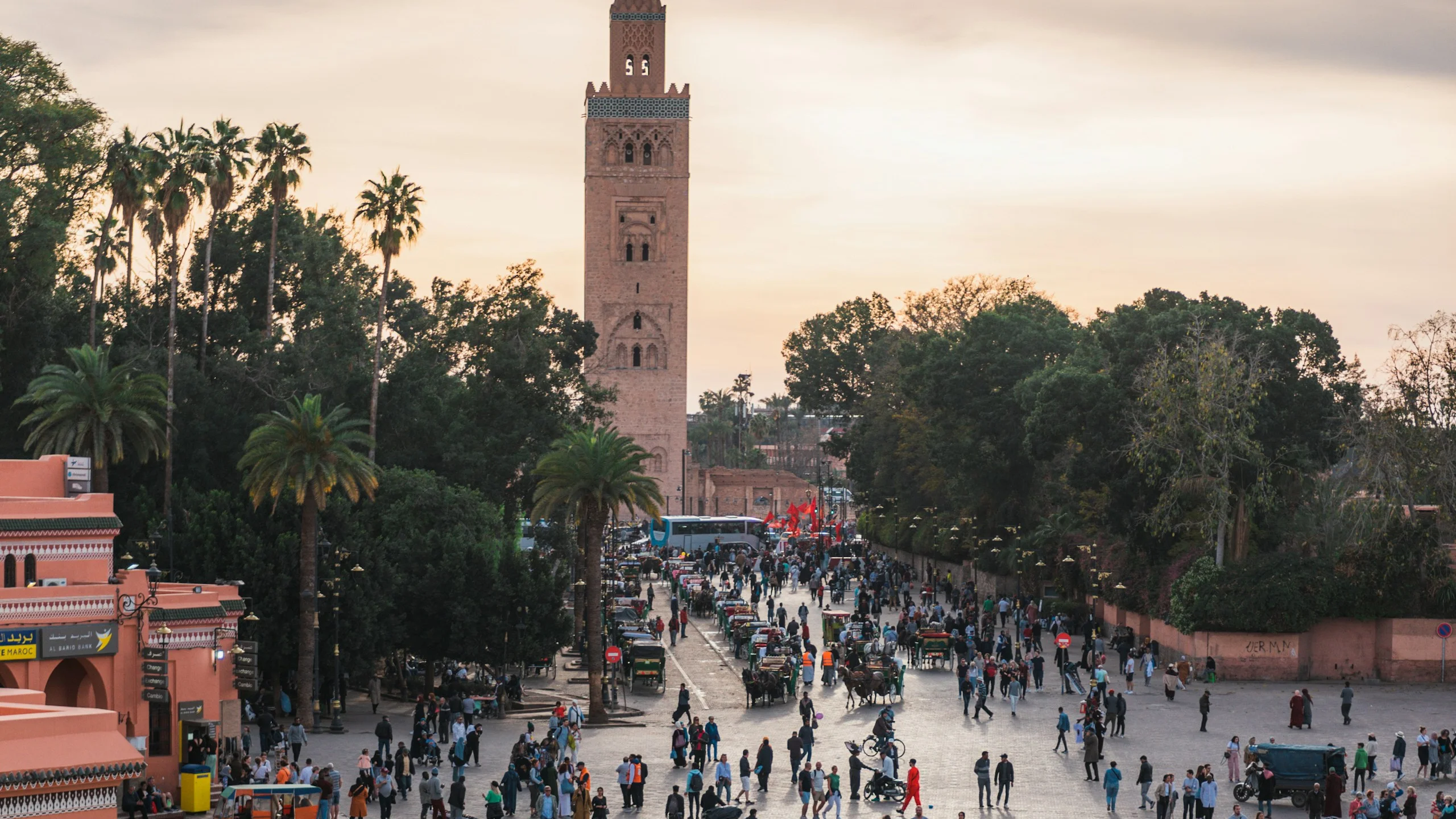
- The famous photo of the Koutoubia at golden hour with the Atlas in the background is most reliable in October
November–December — peak season, peak prices
These months are when the European weekend-break crowd discovers Marrakech, and the city responds with peak rates. Day temperatures stay in the 18–22°C range, evenings get genuinely cool (8–14°C — bring a light jacket), and the riads — most of which have unheated open courtyards — start to feel the chill at night. Many rooftop restaurants close their open-air sections from late November until March. The light is the most cinematic of the year (the November sun angle is famously flattering for photography), but you're paying €350–500 a night for a riad that's €180 in October for genuinely the same experience. Skip November if you can; visit in October instead.
January — the surprise. Crisp, sunny, half-empty, half-priced.
January is the month most travel writers don't recommend, and they're wrong. Day temperatures hold at 18–20°C in the sun, the sky is reliably clear, the Atlas Mountains have snow on their peaks (50km away, visible from any rooftop), and the Medina is actively quieter than at almost any other month — meaning the souks feel more like working markets and less like a tourist event. Riad prices drop by 50% from December peaks. One caveat: nights are genuinely cold (5–10°C, occasionally near freezing), so choose a riad with heating and a fireplace in the salon — it matters more than room size. Some smaller restaurants also close the first week of January for post-holiday renovations. From week two onwards, the city is at its quietest and most photogenic of the year.
Editor's tips
- Choose a riad with hammam and fireplace — Riad El Fenn, Riad Yasmine, La Mamounia all fit this brief
- Atlas Mountains skiing at Oukaïmeden is operational in January — a 90-minute drive from the centre
- The Yves Saint Laurent Museum and Majorelle Garden have basically no queues in January
February–March — shoulder, with one major caveat
February is similar to January in temperature and crowds — clear, cold-night, half-priced. By the second week of March, daytime warmth becomes spring-like (22–26°C) and the city is at its most flowering — bougainvillea, almond blossom, the gardens at their most planted-out. The major caveat for both months: Ramadan. The dates shift each year (Ramadan in 2026 is February 17–March 19; in 2027 it's February 6–March 8). During Ramadan, Marrakech changes meaningfully: most cafés and many restaurants close during daylight hours, the Medina is quieter during the day and dramatically livelier after sunset (when the iftar fast is broken), and the rhythm of the city shifts. Some travellers prize the experience — the post-iftar atmosphere is genuinely magical, and many restaurants run special suhoor menus through the night. Other travellers find the daytime closures inconvenient. Plan around it deliberately, in either direction.
April–May — the second-best window of the year
These two months are the conventional wisdom answer to 'when to visit Marrakech', and the conventional wisdom is mostly right. Day temperatures are 24–30°C, nights 14–18°C, rain is rare, and the gardens are at their fullest. The major drawback is that everyone in Europe also figured this out — and these are the most expensive months after November–December. April is slightly cooler and slightly less crowded than May. Booking 6+ weeks ahead is mandatory for a good riad inside the Medina.
June–September — the difficult months
Marrakech in summer is honestly hard. June is borderline (28–35°C daily); July and August are genuinely brutal (38–46°C in the afternoon, occasionally hotter, no humidity but no breeze either). The Medina becomes uncomfortable to walk during the day — most locals go indoors between noon and 5pm, and you should too. Riad prices drop by 60% from peak rates, so this is the season for travellers who can plan their day around heat (poolside until 4pm, Medina exploration after 5pm, dinner on the rooftop after sunset) and who specifically want the city quiet. September starts cooling by the third week. We'd avoid June–August unless you have a specific reason to be there.
Quick reference: month-by-month one-liner
January — best-kept secret, cold nights, half-priced. February — same, watch for Ramadan some years. March — flowering, may overlap with Ramadan. April — second-best month, expensive. May — same. June — heat starts. July — too hot. August — too hot. September — cooling by week 3. October — the answer. November — peak crowds, peak prices. December — same plus film festival peak. Pick October if you can, January if you want quiet, April if October is sold out.
Find the Best Flight Deals
Prices vary dramatically by month. Compare live fares from hundreds of airlines to lock in the cheapest window for your travel dates.
Where to Stay
From boutique guesthouses to luxury resorts, the accommodation you choose shapes the trip. Filter by neighbourhood, price, and guest rating to find your match.
Tours & Activities
Skip the tourist traps. Book directly with vetted local operators — skip-the-line access, small groups, and money-back guarantees included.
Frequently asked questions
October is the best month: 28–30°C, post-summer humidity break, no European school holidays, and 25–35% below August pricing. Spring (March–May) is excellent for the high Atlas day trips with wildflowers. January is the value pick — cool mornings, clear skies after the brief rainy season, and the quietest medina of the year. Avoid July–August: 40–42°C is genuinely difficult for medina walking.
If forced to pick one month, October. If you want the quietest, most photogenic, most affordable Marrakech, second half of January. If you're tied to a school-holiday window, late April. The two months to genuinely avoid (unless you have a specific reason): July and August. Whichever month you choose, stay in a riad inside the Medina rather than a hotel in Hivernage or Guéliz — the difference between the two is the difference between visiting Marrakech and living briefly inside it. We stand by that read, but safety perceptions shift — cross-check the latest guidance at the U.S. State Department's Morocco advisory before you go.
Get there
Flights
One search across 700+ airlines — find the real lowest fare for your dates.
Search flightsWhere to stay
Hotels
Browse verified hotels and stays — instant confirmation, secure booking.
Book on KKdayThings to do
Activities
Tours, attractions, and day trips — free cancellation on most experiences.
Book on KlookTours & Experiences
Book the experiences, not just the trip
Skip-the-line tickets, guided tours, and day trips — free cancellation on most, confirmed instantly.
About the author
Camille Laurent
Senior Travel Editor · Based in Lisbon · Bali
Camille has spent the last 9 years living in or reporting from over 60 countries. Former contributor to Condé Nast Traveler and Monocle, she focuses on Southeast Asia, Mediterranean Europe, and the Middle East. Currently based between Lisbon and Bali.
Read next — destinations
More from The Edit
When to Go
Best Time to Visit Bali — A Local's Honest Calendar
Eight years of living between Bali and everywhere else taught me that the island has four micro-seasons — and the brochure describes exactly none of them accurately.
11 min read
Itineraries
5 Days in Paris: Where to Eat, Sleep, and Skip
Most first-time itineraries send you to the same eight monuments and the same six tourist-trap cafés. Here is the version we'd actually plan for a friend — by neighbourhood, by meal, and including the things we'd specifically not do.
13 min read
Travel Guides
Slovenia: The Country That Has Everything Europe Charges Double For
A country smaller than New Jersey with an Alpine lake, wine valleys rivalling Tuscany, and restaurant prices that make Vienna look absurd. Slovenia is Europe's best-kept open secret.
12 min read